Wednesday, August 31, 2016

What I've learned from my job search so far

US Capitol photo by Tara Siuk
Two months ago I made a bold move: I quit a job that I liked to find something that better fit my passion for progressive public policy. I had been searching for jobs for a few months before I quit, but I wasn't able to invest much in the process while working full time. As someone who likes to stay busy, having so much free time on my hands made me restless at first. Since then, I've learned a lot that has made me a better person and stronger future employee. Here's what I learned so far, and I hope that this post helps and encourages those in a similar situation:

People want to help
I am extremely grateful for the friends, acquaintances, friend-of-friends, and flat out strangers who have donated their time to meeting with me, shared their experiences, and forwarded job opportunities. I'm still nervous when I reach out to schedule informational interviews, but I nevertheless push myself to do so. It is difficult for me to ask for favors, but I am always pleasantly surprised when I do, and I am eager to pay it forward down the line.

There are many opportunities to learn
Without any obligations during business hours, I'm finally able to attend panels and conferences on subjects I'm interested in, from topics related to my job search (like how to fine-tune your resume) to more academic matters. I've learned about emerging global trends at the Pew Charitable Trusts and youth civic-engagement tactics at the GovHub. LinkTank publishes a great schedule of events in the DC area which I highly recommend, and I make it a point to attend at least one event a week. Not only do I walk out of these events a smarter person, but I get to build my network from meeting other conference goers and by engaging in discussion in person and through social media, In addition to these one-day events, I am also taking an online data science course through JHU/ Coursera to learn new skills relevant to public policy. Many of these coursers are free or very low-cost- I recommend checking them out.

Each job application makes you stronger
After hours and hours of searching for jobs and writing cover letters, I've nailed down my career narrative and identified my clear skill sets. Although it sometimes feels like my job applications go into a black hole, I walk away from each application with a better idea of who I am and what kind of job I want. Each week I find myself making small changes to my resume, and it's growing stronger and stronger. I've received a lot of solicited and unsolicited feedback on my cover letters and resume, and taking the time to implement these suggestions has made them better.

Investing in paid job-search services can be worth it
There are myriad useful, free websites out there, but I'm glad I've invested in some paid ones as well. I bought a subscription to Brad Traverse Jobs, which posts jobs related to public policy and government affairs and found it immediately useful. By consolidating so many intriguing jobs in one place, it is well worth the $5 a month. I also started a free one-month trial of LinkedIn Premium to build my network, find jobs, and make new contacts. At $29 a month, I'm not sure I will continue after the trial ends tomorrow, but it was helpful. In addition to the many online jobs boards, I found these free websites useful for public affairs: Democratic House Resume Bank, House Bulletin, Senate Resume Bank, DC Public Affairs Jobs, and my county government's job board. However, for Capitol Hill jobs--even more so than other jobs-- it really is about who you know, so I am making sure to complement my online networking with in-person networking.

Small goals are important, too
Obviously, my main goal throughout this process is to get a job in my desired field. But setting smaller goals makes me feel more accomplished along the way. An easy goal is setting a target number of applications to submit each week (mine is pretty small because I'd rather focus on crafting the perfect cover letter for a job I really want than send out a bunch of generic ones). I'm thankful that I have enough savings and support from my husband to take this time off to job search. Still, I've set a date a which I will take a part-time job, internship, and/or start temping until I can find a permanent position. That date has given me the confidence and leeway to not give up, as well as something to look forward to.

All work and no play is dull
At first I felt guilty for spending time on hobbies instead of searching for jobs. However, there are only so many hours a day you can check the same job boards again and again. Investing in the things that make me happy, well, makes me happy! I finally got around to making a scrap book for my wedding, volunteering, picking up guitar again, and getting more involved with local organizations. I've even been able to travel a bit and visit some friends and family, and I've read a ridiculous number of books.

My search continues with some hopeful possibilities brewing, but this post is a reminder to myself and others in the same situation that it is not a waste of time. Some days I'm excited by the many possibilities before me, yet others I feel inadequate, discouraged, and hopeless. But that's all ok- this is a learning experience, and we can do this!

Tuesday, May 17, 2016

More than just a woman on US currency

I'm elated that a woman will finally be represented on US paper currency. But why do so few seem to celebrate that a person of color will also be represented? Harriet Tubman, an activist and abolitionist most known for her leadership in the Underground Railroad, certainly deserves her place on the $20 bill. However, her identity as a black women cannot be ignored. If anything, Harriet Tubman is more known for her work fighting against racism than fighting against sexism. Why, then, is one part of her identity celebrated over another? From the mainstream media to nerdy comics to my Facebook feed, people seemed to ignore this part of Harriet Tubman's identity (and I'm not even getting into the straight-up racist reactions).

An imagined Harriet Tubman on the $20 bill.
Source: Harriet Tubman Historical Society
Of course, racism, sexism, and all of these -isms are ultimately connected and perpetuated by many of the same hegemonic power structures. Yet even "progressive" advocates are guilty of perpetuating other -isms.  Many popular feminists like Lena Dunham have been criticized for being "white feminists" insomuch as their work and advocacy excludes the struggles of women of color. (Some feminists of color instead use the term"womanist" instead to separate themselves from white feminists). Speaking of dollars, while white women make only 78 cents on the dollar of what men make, black women make just 64 cents on the dollar and Latinas make 56 cents on the dollar of what men make due to these institutionalized -isms. In fact, some critics lament that putting Harriet Tubman on the $20 goes against everything she fought for by making her a symbol of the oppressive economy she fought against. (Root writer Cedric Mobley has a great response to those critics).
Gender Wage Gap (note that it fluctuates from year to year)
Source: New Republic & AAUW
This post is long overdue, yet the problem remains. Certainly, we need more women, people of color, and other minorities represented on our currency. After all, money is power, and those who we chose to memorialize on currency retain that power symbolically. It should also be noted that Women on 20's, the group that advocated for Harriet Tubman to be on the $20 bill, has a diverse list of women candidates who Harriet Tubman beat out. Let's not make the same mistake when these women get on our currency. Instead, let's celebrate all parts of their heritage & identity.

---

* Case in point: a search for "Harriet Tubman woman $20" on Google News yields 49,700 results, while "Harriet Tubman black $20" yields 31,300 results (and "Harriet Tubman African-American $20" yields 11,880). 31,300 + 11,880 still is less than 49,700. I'm unable to find the original print headlines from April 20, 2016 when it was announced that Tubman would grace the $20, but I'm still sleuthing. 

Wednesday, August 7, 2013

Education not Deportation

I've been working with a student in Maryland who, despite being awarded multiple scholarships, cannot afford to attend community college this fall because he is being charged out-of-state tuition. Even though he has lived in Maryland for five years, has graduated from a Maryland public school, and his mom pays state (and federal) income tax, he is being charged the out-of-state rate because he is an undocumented immigrant.

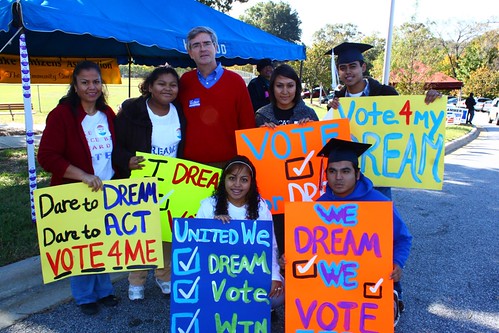
DREAM Supporters and Brad Miller
DREAM activists in North Carolina.
Photo credit: Justin Valas, 2010
Daniel* is a bright, optimistic, and hard-working, young man with a great sense of humor. This summer he's been working long hours at a restaurant to cover the additional cost of school next fall. He's also spent the last few months looking forward to going to college-- until he looked at his bill last week and realized he was being charged thousands of dollars more than he thought.

Many young immigrants face a similar shock when they see their college bill for the first time and realize that they'll have to drop out of school before they even start because they can't afford it. Some students realize this in high school and give up, seeing no point in doing well in school and finishing their secondary education if they can't afford college. A college degree is key to success in the United States. But with little hope of accessing college, some undocumented youth have even committed suicide out of hopelessness.

I'm grateful that the Maryland DREAM Act offers Daniel and other young immigrants an avenue for getting in-state tuition; however, it is a confusing, bureaucratic process. I'm working with Daniel to get his paperwork together this month, but, because he just found out about the process and school starts in a few weeks, he may have to wait until next spring to start college.

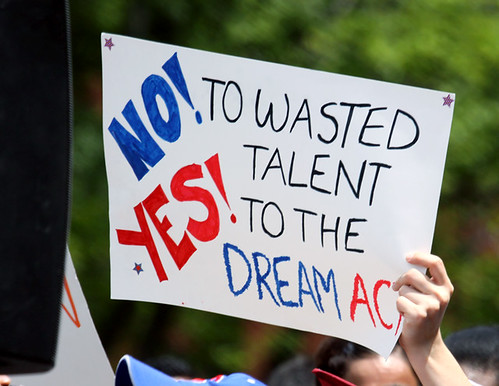
DREAM ACT FOR ILLEGALS
A DREAM Act supporter holds a poignant sign.
Photo credit: ShoreShot Photography.
But what about the states that don't have a DREAM Act? Thirty-eight states, including Virginia, still charge undocumented students out-of-state tuition to attend public colleges. It seems absurd that an undocumented Maryland student can become eligible for in-state tuition, but a student across the Potomac River, in Virginia, is denied that right. But because there is no national policy, even students in states with a DREAM Act are confused about their opportunities. Daniel didn't think he was eligible for it until I walked him through the process.

Thanks to Obama's executive order, undocumented immigrants who were brought to the US as children can apply for DACA (Deferred Action for Childhood Arrivals) and attain legal residency. However, this process also carries with it a mountain of red tape and a large $465 fee (which is cost-prohibitive for many low-income immigrants). It's still up for debate, though, whether or not DACA recipients qualify for in-state tuition. The University System of Georgia, for example, denies DACA students in-state tuition.

The University of Virginia, my alma mater, similarly charges undocumented students out-of-state tuition. UVa tuition for the upcoming school year is $38,026 for out-of-state students and $15,672 for in-state students. The ACLU says it's illegal for UVa and other colleges to discriminate against undocumented students in this way, and they successfully won the right for one undocumented student to get in-state tuition. Other students, however, aren't so lucky.

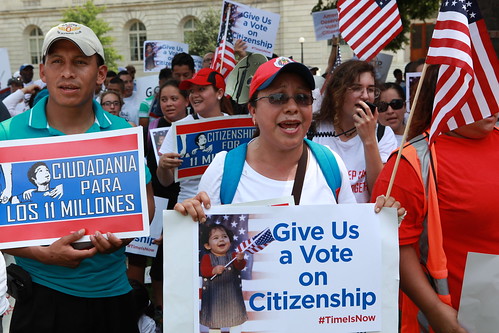
Immigration reform Rally on Capitol Hill
Rally last month in DC for immigration reform. 
Photo credit: Rick Reinhard, 2013
There's no rational argument in favor of charging undocumented students who live in-state anything other than in-state tuition. Undocumented immigrants pay the same state taxes that fund public universities that citizens do. In fact, undocumented immigrants pay more local, state, and national taxes than the 1 percent. In 2010, undocumented immigrants paid $11.2 billion in taxes.

This is just another reason why we need to pass comprehensive immigration reform on a national level and make college more affordable for everyone. If undocumented youth are given legal status, then they can prove their legal in-state residency. I'm lucky that I didn't have to sign an affidavit and prove that my parents paid state income tax over the past three years just to pay in-state tuition.** No one ever questioned my legality. Education is a right is a right that should be accessible for all, regardless of what papers they have.

---

* Name changed to maintain confidentiality
** These are part of the requirements of the Maryland DREAM Act.

Tuesday, March 12, 2013

The Case for Labelling GMOs


I've been following the debate on GMOs ever since watching documentary Food Inc. in my environmental policy class. As part of the job application process, a potential employer asked me to write a response to a contentious issues covered in a news article. I decided to respond to the this weekend's NYT article "Major Grocer to Label Foods with Gene-Modified Content." I'm sharing it here because it's an issue that I'm passionate about. Whether or not you personally prefer eating genetically modified food, I hope you can agree that the consumer has a right to know whether or not their food is genetically altered so that they can make the choice themselves.

Genetically modified organisms (GMOs) have become the norm in the American agriculture industry, yet consumers currently have no way to determine if the food they are eating is genetically modified. The public has expressed a range of personal, environmental, health, and economic concerns related to GMOs consumption, but organizations such as the Grocery Manufacturer’s Association claim that they lack warrants for their claims. On March 9, 2013, the New York Times published an article chronicling Whole Foods’decision to label foods that contain GMOs. Whole Foods is a major upscale grocery chain that primarily sells natural and organic food, and their decision illustrates how labelling GMOs can be profitable. Consumers shouldn’t have to wait for individual corporations to label GMOs, however. The government ought to protect the consumer’s right to know by requiring all GMOs to be labelled.

The New York Times article cites a Mellman Group poll that shows 90 percent of respondents support labelling GMOs. Consumers are hesitant to embrace GMOs for a variety of personal, environmental, health, and economic reasons. Some oppose GMOs on religious grounds, as they believe altering genes is akin to “playing God.” Others are worried about the dearth of studies examining the long term impacts of GMOs on human health and the environment. Similarly, GMO opponents point out that GMOs threaten biodiversity. Others merely want to avoid supporting Monsanto, the largest vender of GMO seeds and their associated products, as it maintains an unchecked monopoly on GMOs.

While the Americans public is very much in favor of labelling GMOs, the agriculture and food industry is vehemently opposed. Opponents fear that Americans will chose not to buy GMOs despite any evidence showing that they negatively impact human health. They correctly show that the Food and Drug Administration, American Medical Association, and World Health Organization have no evidence showing that GMOs are unsafe for consumption. However, the absence of evidence on the dangers of GMOs doesn’t mean that they are inherently safe. Perhaps that’s why the European Union requires all GMOs to be labelled and countries as diverse as Peru have banned GMOs entirely. Moreover even if the GMOs aren’t harmful themselves, they encourage farmers to use more harmful pesticides and herbicides on their crops, as GMO crops are resistant to these chemicals. As a result, the chemical runoff from GMO crops poisons soil and water resources.

Since non-GMO products tend to be more expensive than their counterparts, opponents might also argue that other grocery chains won’t be able to afford to make the same choice as Whole Foods, as Whole Foods is an upscale grocery atypical of the rest of the industry. Yet the New York Times article states that more than 20 other corporations that sell food products, including Wal-Mart, met last week to consider labelling GMOs as well. Moreover, some consumers prefer to buy GMOs because they are cheaper, have a longer shelf life, and have other enhancements. Whole Foods isn’t refusing to sell GMOs; it’s giving consumers enough information so they can choose what’s best for them.

Despite studies showing extensive support for labelling GMOs, last November voters narrowly failed to pass a stateballot initiative which would require the labelling of GMOs in California. Corporate interests spent billions of dollars to defeat the cause, which is why the government must intervene at a federal level. Consumers have expressed their right to know what’s in their food, and they’ve cited a variety of valid personal, environmental, health, and economic reasons. The government ought to require the labelling of GMOs so that consumers can be given the product information they need to make the right choice for themselves, otherwise corporations will unfairly make that choice for them by refusing to label their products.

***

Visit Just Label It to learn more about the campaign to label GMOs.

Wednesday, December 5, 2012

Scratch the Single Sanction

The University of Virginia is an institution built on tradition. From its pretentious, but beloved vocabulary (grounds, not campus!) to its Southern charm (guys in ties/ girls in pearls), from living on the Lawn to streaking the Lawn-- the UVa community is quick to embrace its history and hesitant to question it. And what's perhaps one of the oldest, and most outdated institutions at UVa? The student run Honor System and its Draconian single sanction. Each student that applies to UVa signs the honor code (never to "lie, cheat, or steal") on their application and then re-takes the oath during convocation. Many schools have honor systems similar to UVa's student run Honor Committee, but what makes UVa's Honor System truly unique is the single sanction- that if a student is found guilty of breaking the honor code there is only one available punishment: expulsion.

From the 2012 Student Survey on Honor
Recently two students were expelled for cheating on a biology test. Rumor has it that a handful of engineers were also expelled this week for a similar cheating scandal. In the meantime, those guilty of rape and sexual assault face little or no punishment. The rational behind the single sanction is that UVa wants to create a "community of trust" through the threat of a punishment so severe that no "rational" person would consider breaking the honor code. Despite the harsh, punitive the 2012 Student Survey on Honor reveals that 60% of UVa students have not reported observed honor violations. Moreover, 83% of students admit that “uneasiness about the student being dismissed” would deter them from reporting an honor violation. Evidence shows that the single sanction does the opposite of its intended purpose.

Last October I participated in the Ethics Debate, an annual debate between the Washington and Jefferson Societies literary and debating societies at UVa. This year we changed the format and held the debate as an exhibition in front of the Honor Committee and Dean of Students. The topic? Resolved: The single sanction is unethical. Much of the content of this post is taken from my constructive speech, which I wrote with the help of my partner, Ben, and Sam, a Wash member who I debated with in debate tryouts. Nevertheless, I've decided to publish it because I sincerely believe that the single sanction ought to be abandoned in favor of a multiple sanction system. In our presentation we used three standards of justice to gauge whether the single sanction is ethical as a punishment or not: that punishment ought to be 1) proportional, 2) preventative, and 3) rehabilitative. The single sanction meets none of these standards, which is why it is unethical.

Proportional justice maintains that criminal punishments ought be tailored to the crime. This is something we all intuitively understand: stealing ten dollars from the cash register is not equivalent to stealing someone’s car. Hence it makes sense that our legal system treats these crimes differently and gives a much more severe punishment for grand theft auto. Crimes against the honor code can be very different too: Is lying about the severity of an illness to miss a test the same as turning in an essay downloaded from the internet? Is taking an additional piece of fruit from Runk the same as embezzling money from your CIO? With such variation in crimes, uniform punishment can’t possibly be adequate, yet we have here a system that by its very name is defined as just that: a option for sanctions. However, more choices of punishment mean that you can properly match a crime to its retribution.See, honor offensives don’t exist within a binary system; rather, they exist on a continuum in which different offensives merit different responses. The Honor Council at William & Mary, for example, provides a more ethical template of a swathe of punishments including a recommendation for a failing grade in the course, community service, and academic probation. It may be ethical to allow for the expulsion of a student in extreme circumstances, but having additional options better enables us to acknowledge this spectrum.

UVa Honor Logo
Secondly, the single sanction does not uphold preventative justice.The idea behind preventative justice is that punishments ought to be designed as to discourage people from committing crimes. As I already mentioned, the single sanction is so Draconian and unrealistic that it actively prevents students from reporting honor violations because very few students want to see their peers expelled. Results from a 2006 Faculty Survey on Honor also reveal that a majority of faculty members are hesitant to report honor offensives because of doubts about the single sanction. If an incident isn’t reported to them, the honor system has no power to prevent further issues whatsoever. Additionally, Honor cannot punish trivial cases with the Single Sanction, and thus there is no disincentive from committing trivial honor violations! As a result, most students who commit even “mid-level” honor offenses that are not deemed sufficiently egregious so as to merit expulsion are merely let off the hook with no punishment.

Furthermore, the single sanction goes beyond failing to prevent honor violations and instead encourages students to lie during their trail. When accused students enter their honor trial, they are incentivized to lie through their teeth to avoid being expelled because if they lie and get caught, it doesn’t matter because they were going to be expelled anyway. When there are gradual punishments, however, a student is encouraged to tell the truth to gain the trust of the jury in order to be given a lesser punishment.

Lastly, the single sanction disregards the possibility of rehabilitative justice. The premise of rehabilitative- or restorative, justice is that institutions ought to react to crime in a way that seeks to rehabilitate the accused in the hopes of restoring the community. Obviously, the Single Sanction does not do this -- it gives convicted students no second chance, no opportunity for further education, no chance to learn from their mistakes and make amends for their crimes against our community. In fact, by encouraging lying during trials (as I previously mentioned) the single sanction makes students repeat offenders instead of rehabilitating them!

Furthermore, the single sanction violates many of the UVa community’s values such as learning, tolerance, understanding, forgiveness, & Jeffersonian humanism. We don’t expect students to know everything immediately upon entering the university; education is the primary purpose universities after all, yet students are bound by the honor code immediately upon their arrival and subject to the Single Sanction. How can a punishment system that expels you for a single infraction be ethical if, according to the 2012 Student Survey on Honor, about 50% of UVA students have not heard about the Honor Code prior to arriving on grounds? People don’t magically and instantaneously assimilate into our system, and the single sanction means that people only get a single chance.
This totally denies the opportunity for rehabilitative justice and fails to accomplish the mission of a great University such as ours. We have seen that the single sanction is inconsistent with all three of the major perspectives on punishment: proportionality, prevention, and rehabilitation. As one faculty member reported in a 2006 Assessment on Honor:
The System itself does not exemplify the morals we would nurture in our students: it is not responsive to the particulars of a person's situation; it is neither nimble nor wise; and it is not merciful or humane. Instead, it is rule-bound, cumbersome, and essentially punitive.
While the single sanction certainly has a storied tradition at this school, that does not make it ethical. I decided to publish our speech (even though my partner Ben marginally supports the single sanction) to continue the discourse on this defining element of our university. Every few years the Honor Committee brings the single sanction to referendum, and hopefully one of these years it will be defeated in favor of a more just system.

Tuesday, November 27, 2012

Service-learning: About giving or recieving?

I have a lot of qualms with the "hug an orphan" service trips which are frequently marketed in college campuses, most of which revolve around thoughtlessly enabling white, upper-class privilege. In these trips, which range from visiting orphanages in Guatemala to clinics in Tanzania, students are encouraged to "do good" by going abroad and imposing their notions of development on communities who lack the power to reject their advance. In the meantime, students can turn a blind eye to poverty in their own community and their role in perpetuating global inequality.

The students have a privilege afforded by their wealth that gives them-- and morally justifies-- their global mobility. On one hand, inexperienced college students are celebrated for "playing doctor" in small rural communities in Africa or attempting to build houses in Nicaragua. On the other, when people from other cultures come to the US to contribute to our economy-- much like undocumented workers from Latin America do-- we do everything we can to make them feel unwelcome.

Anyway, yesterday UVa's newspaper, The Cavalier Daily, published an editorial I wrote in response to a Youth- Nex study which found that UVa service-learning projects "succeed." The study defined success purely in terms of the project's impacts on students, ignoring the consequences for communities they visit. I refer to a 2011 Jefferson Public Citizens (JPC) project in Jamaica where the students tried to ecologically remodel a house without a building permit, resulting in the eviction of a woman (who then became homeless) and the demolition of the historic building. By the terms of the Youth-Nex study, the project "succeeded" because they students learned from their mistakes and improved their communication skills. The effects on the woman and her family & the historic district were ignored. If the University is serious about service-learning (which is an idea that needs more critical examination in the first place), then it needs to value the impacts of its projects on students and community members equally.

So, if you're interested, check out my editorial "Re-evaluating JPC's success." More importantly, let's change the conversation on service-learning projects so that it's not merely about the students. Giving a service isn't "good" in and of itself- there needs to be more consideration for what exactly the community is receiving, if they want it in the first place, and what the long term impact will be. And that should be the first priority.

Let's even reevaluate why there is such an impulse for these projects in the first place.

Monday, July 30, 2012

Reflections on Lake Titicaca


Taquile and Lake Titicacaca
After preparing for three weeks in Lima, I just recently returned from spending nearly three weeks in Puno, Peru studying the cultural impact of rural home stay tourism (turismo rural viviencial) on the islands of Amantaní and Taquile on Lake Titicaca. None of it would have been possible without my lovely friend and research assistant Jenni from La Ruiz whose thoughtful questions enriched the quality of my research. After conducting over 50 interviews, living with four different host families, and spending countless hours observing and interacting with the islanders, I'm left with a notebook full of transcriptions, a camera full of memories, and a head full of thoughts and unresolved questions, including the somewhat superficial question of how to explain the broad social and cultural changes in the islands in a blog post.

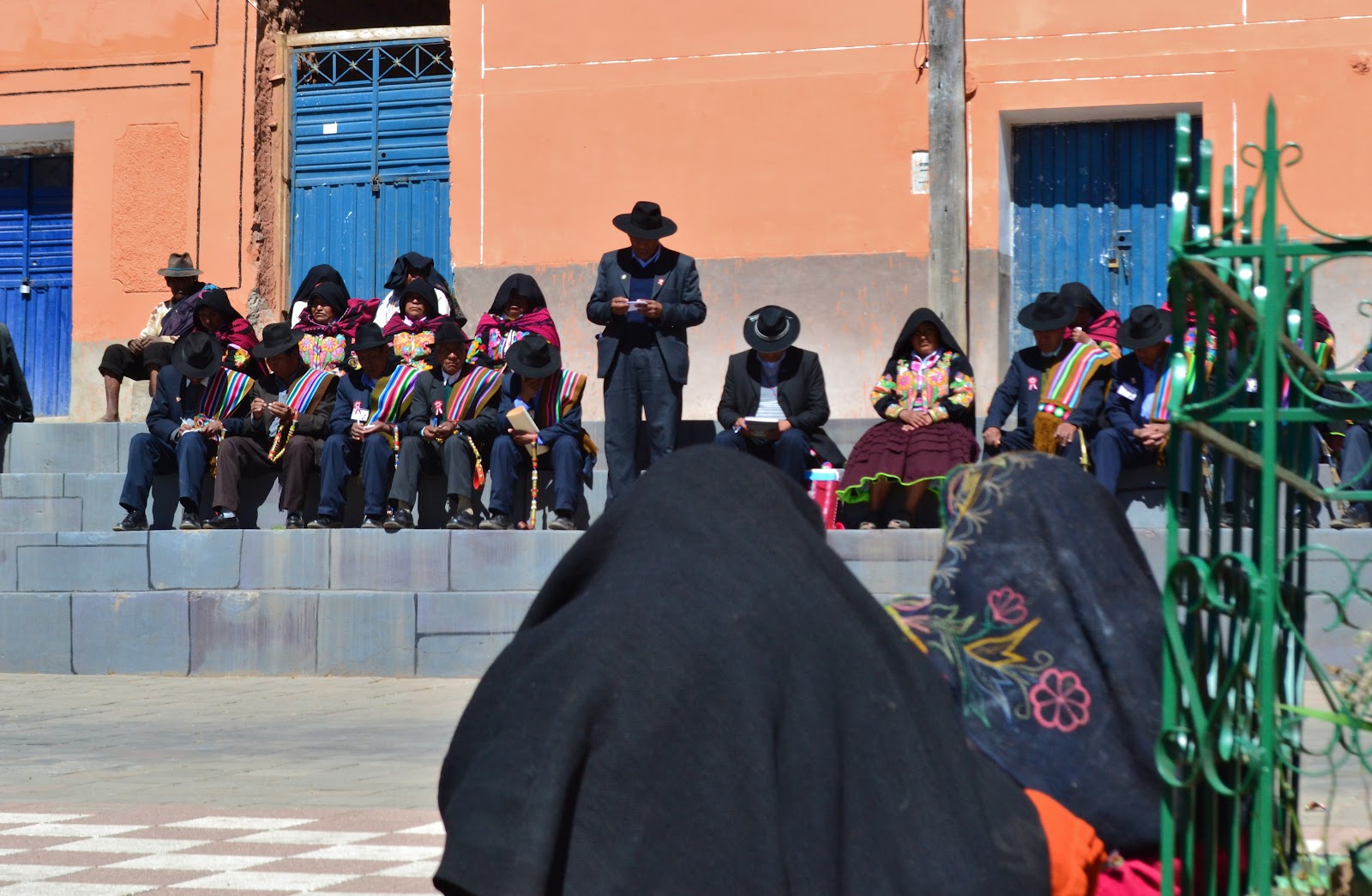
Amantani's leaders addressing the town on Sunday
Although neighbors Amantaní and Taquile both rely on tourism as their only source of revenue (outside of artisan crafts- a subsidiary of tourism- and remittances from migrant workers), their experiences with tourism are surprisingly distinct. Whereas Taquile has a longer experience with tourism (it became the first rural community in South America to develop a type of home stay cultural tourism in the 1970s), the islanders there are also much more disillusioned and distant. That's not to say that Amantaní's experience is perfect, but the residents there have been organizing themselves to mitigate the strongest negative effects of the capitalist industry of tourism: the erosion of the community in favor of the individual.

Our amigo Franklin
On Amantaní, our host family welcomed us with open arms, and Jenni and I quickly befriended the children of the household. Because the teachers had been on strike in the region for a month, we made sure to take a little bit of time each day to play games with our new friends, whose curiosity and thirst for knowledge was inspiring. Overall, the amantaneños were optimistic and excited to welcome tourists into their home. Most everyone was proud of the new law that the mayor passed this year, the Law of Rotation, which rotates tourists between each of the 10 communities on the island to more equitably distribute the benefits (all under the oversight of the recently established Tourism Committee). Then again, the islanders seem to invest so much hope in tourism out of necessity. Fierce competition in the past pushed prices so low that few have recovered from the large investments they made in constructing rooms and bathrooms for tourists. The economic benefits from tourism are often sighted as the strongest benefits of tourism, enabling families to buy more nutritious food and school supplies for their children, but they still aren't substantial. Nevertheless, a spirit of optimism persists in Amantaní.
One of our host dads, Celso, a critic of tourism.


Yet when we arrived in Taquile a week later, we immediately felt a thick distance between us and the islanders. We were served different food in a separate kitchen according to what they thought tourists liked (omelets, french fries, white rice). "En provencia" (or in the countryside) it's common courtesy to greet someone when you pass by them on the mountain paths, in Taquile half of the islanders ignored our greetings. Many denied our requests for interviews and some even accepted but didn't end up showing up to the interview.

What happened?

Provoked by the neoliberal reforms of President Alberto Fujimori in the 90's and the greedy ambitions of Punean tour agencies, Taquileans slowly abandoned the community organizations which once regulated tourism for the greater benefit of the community in favor of more lucrative structures. Although Taquile's main attraction is its cultura viva ("live culture"), the old culture is only maintained superficially. The islanders wear their trajes de fiesta (formal traditional cloths) every day in the streets, but frequently don more comfortable and warm modern clothing in their homes. The men and women continue knitting their artisan wares ( recognized by the UN in 2005 as a Masterpiece of the Oral and Intangible Heritage of Humanity) although they now produce lower quality items such as hats, berets, and gloves because of the tourist demand. Yet while these visible symbols of culture persist (albeit very forcefully), the spirit of the community has disappeared. 

Taquilean crafts in their collective.
In the past, the residents of Taquile lived through subsistence agriculture, not being able to grow enough to sell, but enough to trade with nearby communities. Public works were central to the development in the island. Ayni- an ancient Inca form of reciprocity- meant that if your family member needed to build a house that you would help for free, as you could count on your family member to return the borrowed labor when you needed to construct a house. Hoy para mí, mañana para ti. Accustomed to the income from tourism and capitalistic habits learned when working as migrant workers in urban areas of Peru, islanders now expect to be paid. Instead of working together, there is competition, conflict, greed, and envy in many parts of public life, and many islanders are conscious of it.

Furthermore, the islanders' own desire to receive more tourists has led taquileños to construct more rooms to the point that tourists outnumber them in their own homes, explaining why islanders now retreat to eat in a separate kitchen in order to maintain their privacy and intimacy. However, the human connection, intercultural exchanges, and relationships that once made community tourism so valuable have disappeared as a result. Because of this hostility (and the unsolved problem of the lack of running water) only about 10 of the daily 200-300 tourists that visit the island stay the night there, meaning a huge loss of revenue for the islanders. Whereas Taquile used to be self-sufficient, now there is a complete dependence on the highly volatile tourism industry. Many taquileños commented powerful statements such as "Tourism is life" or "Without tourism there is no life." This once self-sufficient island now seems to have very little control of the lucrative industry of tourism, which is running wild and nearly unchecked.

Globalization in action.
While the cultural changes on the islands need to be understood within a larger context of globalization, climate change (which has negatively effected the crops, especially on Amantaní), rural-urban immigration, and the emergence of neoliberal politics, there is no doubt that tourism, by far the greatest source of supplementary income for the islanders, has served as a potent catalyst for cultural change.

There is still so much to be said and so much to be learned. Overall, my experience on the islands was bitter sweet. I am so incredibly grateful to have had the opportunity to meet such intelligent and interesting people and to explore the history, cultural, and nature of the islands (from the terraced mountains with roaming sheep to the tranquil shore of the Lake Titicaca to the unbelievably clear sky in which you can see the Milky Way). I'm equally thankful for the insight of Punean intellectuals like Martha and Christian who have refined my study and helped me to synthesize my thoughts. Yet it's devastating to see the effects of tourism and to have been part of this fundamentally unsustainable system. I can only hope that Amantaní continues to move the right direction by recovering community control of the industry, and that Taquile follows its example. There is still so much to say about the changed impulsed by tourism, and hopefully I'll have time for more detailed posts later. In the mean time, I'm more than happy to talk about my project with anyone and hear thoughts and comments.

***

Disclaimer: I don't want to discourage anyone from visiting the islands, as I really did enjoy my experience there and the industry is crucial to their livelihood; however, do recognize that the process of cultural/ community/ home stay tourism is inherently unsustainable. If you do decide to go to Taquile or Amantaní, don't just stay a few hours- stay a few nights and develop a relationship with your family outside of the capitalistic relationship of just paying them for their service. Avoid tour guides and agencies, which are known to not pay the families their asking price and to not pay on time, and take a collective boat to get to the islands and pay the family directly. Respect the local laws of rotation, and don't buy crafts from children (though feel free to give them school supplies, something for which their parents have repeatedly expressed gratitude). Respect the local culture, including its changes.

Culture is not something that is frozen and exists apart from time, as the guides would have you believe. Culture changes, but the question is whether it changes willingly or because of exogenous forces. Tourism has impulsed both kinds of changes, for better or worse.

***

You can read my thesis here: “TOURISM IS LIFE” - Reflections on The Cultural Impact of Tourism on Amantaní and Taquile, Islands on Lake Titicaca in Puno, Peru. Copyright Krista O'Connell 2012. Please cite/ attribute when using.