School started yesterday! Here are some quick observations:
- For my classes so far, I've gone to the classroom one or two minutes before my class is supposed to start and found it empty. Each time I panic for a few minutes and fear that I'm in the wrong room, but then the rest of the class casually floods in.
- Understanding the professors isn't nearly as hard as I thought (except for the professor from Uruguay, who has a thick accent. I might drop his class though). Understanding my classmates, on the other hand, is much more difficult.
- Although there are readings for each course, we aren't expected to buy the books. Instead, we pick up the readings every week from the photocopier or make our own copies from the books in the library. At least, I'm pretty sure that's the system. I'm still confused.
- I'm slowly realizing that I'm the awkward foreign kid. :(
- Very few students use lined paper to take notes. Instead, practically everyone uses graph paper.
- The cafeteria food is delicious. Lunch (not dinner) is the primary meal here, so we are served two dishes a day at lunchtime. I don't remember the names of the dishes we've had, but they're great!
- It's interesting to see some of the same college cliques here in Peru. Hipsters, nerds, preps- we've got 'em.
- For those who are curious, I'm taking State and Society in Peru, History of Peru I, and Directed Spanish Readings. I'm also currently in Political Systems and Regimes, but I'm probably going to drop it to take Social Movements and Conflicts instead.
Well, that's all folks. More retrospective posts to come later.
Tuesday, March 15, 2011


Monday, March 14, 2011
Exploring Lima


Well, that's all for now. I start classes tomorrow... though I only have one class on Mondays and Wednesdays. I'm a little nervous, but mostly excited. Hasta luego!
Wednesday, March 9, 2011
Mountains and jungles and mudslides- oh my!

In Tarma we retraced part of the Incan trail, our footsteps impacting the same earth that the Incans did. We walked alongside medicinal herbs that were supposed to bring good luck or love, used in tequila, and said to cure cancer. Our guide, Jose Louis, was a curandero and Andean priest. He explained the significance of everything we passed, having an ancient connection to the place. I really admire his perspective on life.

Jose Louis was also the night guard for the Hacienda Santa Maria, the beautiful hotel where we stayed. Our room once housed a Peruvian general (and later president) who was on the run from Chilean invaders. The Hacienda had a gorgeous flower farm, adorable dogs, a cat, and a vicuna, and beautiful, colonial architecture.


Later we went to the Sunday market. Women sold fruits, vegetables, and potatoes of all varieties. Some vendors sold live chicks and others giant snails. The streets were inundated with people and goods. It was a colorful chaos. We spent the rest of the day driving to Pichanaki, a newly established town in the jungle (aka Amazon Rainforest). For the two nights we were there we ate pizza at a German restuarant... something I was not expecting.
The next day in Pichanaki, we visited a secondary school whose library was named after the Professor. There was a big reception for our group because of their respect for him and because he brought more books for the library. We were interviewed for a radio show and were said to be on the cover of the local newspaper the next day. Mira- gringas! We later talked to some of the 12th graders there, though most of them weren't interested. The younger kids were more fascinated by our visit and our American look. Indeed, everywhere we have gone we stand out like white polar bears in the jungle (Lost reference!). In fact, I'm actually tall here.

On the way back to town, we saw two rainbows in the sky- perfectly fitting, as the rainbow was the symbol of the Incans.
We woke up at 4am the next day to leave for Lima. Even the trip back was an adventure. A mudslide in the road cost us 2 hours, though some were waiting for it to be cleared for 9 hours. We finally arrived back in Lima around 4pm yesterday. Now it's time to start a new day and a new adventure!
Thursday, March 3, 2011
¡Qué paja!
 I started this morning with a video chat with mi novio querido, Chris. Even though he had little sleep, he woke up early to talk to me. It was so comforting to see his face. :) I am so glad to have Wifi in my house, even though it wavers in and out. By the way, the house I'm living in is a narrow, two story condo (foto to the right). It's very beautiful, though different from what I expected. There is a tiny courtyard in the back used to dry clothes, along with a spiral staircase that attaches this condo with the one above, which belongs to Charo's sister. It's very cute, though more modern than other casas.
After breakfast (un cereal peruano) my host mama took me for a walk around our district of Lima, called Miraflores. She explained how the city has changed over the past few years, and how traditional houses are being replaced by tall, unfriendly buildings- undoubtedly a side effect of globalization and industrialization. Last night, Patricia (who works at Ruiz) told us the same story. Lima does indeed have the look of a torn city. On hand hand, there are beautiful, colorful houses with a garden courtyard in the middle. Por otro lado, there are tall buildings (but not skyscrapers) with a modern-industrial feel right next to them. Yet also, there are some protected pre-Columbian mud buildings (?) preserved throughout the city. However, these new complexes have no personality, and could belong to any city in the world. I can only wonder what Peru looked like before these changes.

We ate lunch at Ruiz with our companeras, which consisted of a traditional potato dish (papas huancainas) and, interestingly, spaghetti. We talked for a few hours with our companeras, who are so friendly and kind! I'm still getting used to speaking in Spanish all of the time, so sometimes it's difficult to understand them, but they are very helpful. Mi companera is named Jennifer and she studies political science. We talked about classes, politics, los chicos, and other things. She's also studying English, so we are going to practice English too. She taught me some Peruvian slang, namely ¡Qué paja! (the title of this entry) which means, essentially how good/ cool/ pretty. I can't wait to get to know them better, and look forward to starting classes!
Well, that's all for now. We are meeting at six tomorrow to embark on a five day trip to Tarma and Pichunaki. We are going to visit an old hacienda, trek in the Andes for a day, and visit the jungle! I won't have computer access til then, but I should be able to text on my cell phone. Entonces.. hasta luego!
***
As I write these blog entries, I understand more and more why the imperfect tense in Spanish is so useful jaja.
Life in Lima
Day 1
Before arriving in Peru, I, along with the four other students studying abroad from my university, was tasked with writing a paper about my expectations for the trip. While on the plane, I found it difficult to concentrate on my assignment, instead thinking about how much I already missed my family and my boyfriend. I had no idea what to expect for the next five months and that baffled me. I now realize that is part of the excitement and adventure.
Day 2 I woke up early the next day in order to get to the Universidad Ruiz Antonio de Montoya (Ruiz, as the locals call it) for orientation. Ruiz will be hosting me and three other students from UVA. My host mama showed me how to walk to the bus stop and what route to take to school. When we arrived, I was stunned by the beauty of the campus, tucked away in a compound in the middle of the city. There was a large courtyard with vibrant green trees, colorful flowers, and birds. All of the buildings were plaster and painted with a light coral color. Classes don't actually begin until March 14th, and we will be using the time until then to explore Lima. This Friday we leave to visit a hacienda and go trekking in Tarma and explore Pichunaki.
At night we went to Larcomar, a large outdoor mall on La Costa Verde, the cliff on the Pacific Ocean. We saw the sunset from the cliff, and it was absolutely astounding. My camera died after taking one picture, but here it is! You can vaguely make out the silhouette of a statue of kissing lovers. Unfortunately, pickpocketing is very common here, so I cannot bring my nice DSLR with me and I forgot the charger for my point and shoot at home. Thankfully, fellow UVa-ite Bridgette has the same camera and therefore the same charger! Ole!

After watching the sunset, we walked around the mall for a bit, and it felt like we had been transported back to America. As Bridgette observed in her blog, the mall was full of American stores and restaurants like Chili's and Starbucks, and the movie theater was strictly showing American films. We then went to Cafe Cafe for drinks before dinner, and we tried the national drink of Peru- pisco sour, a drink that tastes like an icy, sweet gin and tonic.
Later we traveled a few blocks over to have the extremely popular chifa (Peruvian-Chinese food) with the other national drink of Peru, Inca Kola (which tastes like a combination of carbonated cough medicine and melted dum dums). Paco, one of the coordinators from Ruiz, informed us that Peru is the only country where a national soft drink (Inca Kola) outsells Coca Cola. Globalization for the loss! We then walked around the Miraflores area for a bit and passed by a few places I hope to explore later including a fair trade store, indie coffee shop call Arabica, plaza packed with homeless cats, and a beautiful colonial church. I'm so glad I have 5 months to spend here! :)
Before arriving in Peru, I, along with the four other students studying abroad from my university, was tasked with writing a paper about my expectations for the trip. While on the plane, I found it difficult to concentrate on my assignment, instead thinking about how much I already missed my family and my boyfriend. I had no idea what to expect for the next five months and that baffled me. I now realize that is part of the excitement and adventure.
After a seven hour plane ride, we finally arrived in Lima where three representatives from our host university met us at the airport. Despite the fact that it was now two o'clock in the morning (and that we were supposed to have arrived 2 hours before) they were extremely friendly, happy, and eager to meet us. However, my first impression of Lima was a little disappointing- a dense fog covered the city and the streetlights only seemed to illuminate extensive graffiti and security fences.
They dropped us off with our host families by three in the morning, and I talked with my host mama for a bit before we went to bed. She explained that all Peruvians go by a nickname, and that she goes by Charo (short for Rosario). She immediately came off as an extremely generous, kind, and respectable person. One of her acquantinces from Bolivia is also living with us in the house while she looks for a job, and she may be hosting another foreign student that will be studying at a different university. Charro has already proven to be a great host, and I can only hope that my limited Spanish skills adequately convey my gratitude.
Day 2
 I woke up early the next day in order to get to the Universidad Ruiz Antonio de Montoya (Ruiz, as the locals call it) for orientation. Ruiz will be hosting me and three other students from UVA. My host mama showed me how to walk to the bus stop and what route to take to school. When we arrived, I was stunned by the beauty of the campus, tucked away in a compound in the middle of the city. There was a large courtyard with vibrant green trees, colorful flowers, and birds. All of the buildings were plaster and painted with a light coral color. Classes don't actually begin until March 14th, and we will be using the time until then to explore Lima. This Friday we leave to visit a hacienda and go trekking in Tarma and explore Pichunaki.
At night we went to Larcomar, a large outdoor mall on La Costa Verde, the cliff on the Pacific Ocean. We saw the sunset from the cliff, and it was absolutely astounding. My camera died after taking one picture, but here it is! You can vaguely make out the silhouette of a statue of kissing lovers. Unfortunately, pickpocketing is very common here, so I cannot bring my nice DSLR with me and I forgot the charger for my point and shoot at home. Thankfully, fellow UVa-ite Bridgette has the same camera and therefore the same charger! Ole!

After watching the sunset, we walked around the mall for a bit, and it felt like we had been transported back to America. As Bridgette observed in her blog, the mall was full of American stores and restaurants like Chili's and Starbucks, and the movie theater was strictly showing American films. We then went to Cafe Cafe for drinks before dinner, and we tried the national drink of Peru- pisco sour, a drink that tastes like an icy, sweet gin and tonic.
Later we traveled a few blocks over to have the extremely popular chifa (Peruvian-Chinese food) with the other national drink of Peru, Inca Kola (which tastes like a combination of carbonated cough medicine and melted dum dums). Paco, one of the coordinators from Ruiz, informed us that Peru is the only country where a national soft drink (Inca Kola) outsells Coca Cola. Globalization for the loss! We then walked around the Miraflores area for a bit and passed by a few places I hope to explore later including a fair trade store, indie coffee shop call Arabica, plaza packed with homeless cats, and a beautiful colonial church. I'm so glad I have 5 months to spend here! :)
Monday, December 6, 2010
No Impact Man: The strength of individual action
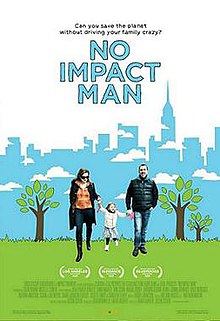
 , a fascinating documentary about Colin Beavan and his family who, in the midst of the chaos of New York City, decided to revolutionize their lifestyle and eliminate their environmental impact for one year. They gave up everything from using toilet paper to riding escalators, set up a compost bucket in their apartment, and eventually stopped using household electricity (which meant no refrigerator, television, or lights). The Beavan family used their individual power to challenge systems of unsustainability and to inspire greater collective action.
What's fascinating about Colin's project is that in the process of lessening his impact on the environment, he drastically improved his own life. He ate healthier by eating fresh, local (non processed) food and he was able to spend more quality time with his family by eliminating most digital technology from his household. He saved his family a substantial amount of money by reducing uneccesary purchases and buying used goods instead of new goods.
However, Colin also faced severe criticism. Some claimed he was doing the project for fame and fortune (he wrote a book
 about his experience) instead of for altruistic reasons. Other environmentalists claimed that his radical actions tainted their imagine. I found it easy to join the critics at first, as his plan wasn't flawless and included some hypocrisies. Yet in many cases, it's easier to criticize than to take action.
Colin was contributing to the dialogue in green living and using his individual power to create change. The purpose of the book and documentary was to inspire collective action. As he says, "The fact of the matter is that if only I change, it's not going to make a difference, but the hope is that if each of us as individuals change, it's going to inspire everybody to change. So I believe the most radical political act there is, is to be an optimist. The most radical political act there is, is to believe that if I change, other people will follow suit."
It will take decades to revolutionalize corporate and political institutions for the maximum benefit of the environment. However, as Vaclav Smil said, "There is no faster, easier fix for America's energy crisis than to simply begin living with rational limits." We can't wait for the system to change, we must change it ourselves by thinking globally and acting locally.
Since watching the film, Chris and I have talked about committing a week to the No Impact Project this January. Although it wasn't directly addressed in the movie we've also considered eliminating high fructose corn syrup from our diets because of the disaster it reeks on your health (obesity), the economy (corn subsidies), and the environment (food processing). We also hope to have a Green Christmas by wrapping our Christmas packages with recycled materials like newspapers or paper bags and purchasing mostly eco-friendly and fair trade items.
For more information on the No Impact Experiment and a trailer from the movie, check out this video.
For more information on the No Impact Experiment and a trailer from the movie, check out this video.
Sunday, September 26, 2010
Voter Registration Apathy
Though I haven't posted much recently, have no fear, as I have lots of pent up political angst!
In the meantime, here's a link to an editorial I wrote for UVa's newspaper, The Cavalier Daily, entitled "The privledge of voting" regarding voter registration apathy among college students.
So, if you live in Virginia and aren't registered to vote, print out a form from the Virginia State Board of Elections and mail it in by October 12th!
In the meantime, here's a link to an editorial I wrote for UVa's newspaper, The Cavalier Daily, entitled "The privledge of voting" regarding voter registration apathy among college students.
So, if you live in Virginia and aren't registered to vote, print out a form from the Virginia State Board of Elections and mail it in by October 12th!
Subscribe to:
Posts (Atom)