Showing posts with label culture. Show all posts

Monday, July 30, 2012

Reflections on Lake Titicaca


Taquile and Lake Titicacaca
After preparing for three weeks in Lima, I just recently returned from spending nearly three weeks in Puno, Peru studying the cultural impact of rural home stay tourism (turismo rural viviencial) on the islands of Amantaní and Taquile on Lake Titicaca. None of it would have been possible without my lovely friend and research assistant Jenni from La Ruiz whose thoughtful questions enriched the quality of my research. After conducting over 50 interviews, living with four different host families, and spending countless hours observing and interacting with the islanders, I'm left with a notebook full of transcriptions, a camera full of memories, and a head full of thoughts and unresolved questions, including the somewhat superficial question of how to explain the broad social and cultural changes in the islands in a blog post.

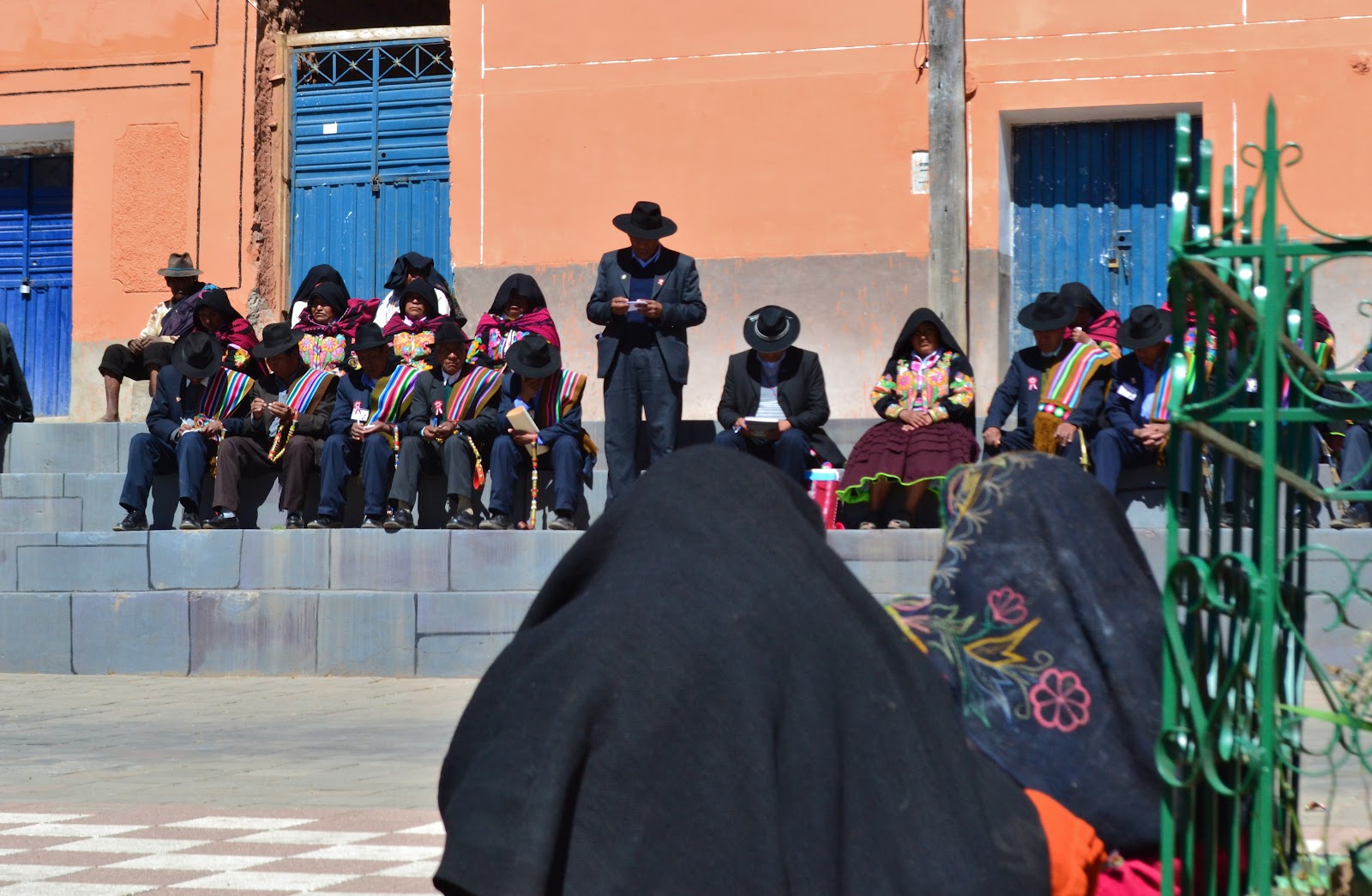
Amantani's leaders addressing the town on Sunday
Although neighbors Amantaní and Taquile both rely on tourism as their only source of revenue (outside of artisan crafts- a subsidiary of tourism- and remittances from migrant workers), their experiences with tourism are surprisingly distinct. Whereas Taquile has a longer experience with tourism (it became the first rural community in South America to develop a type of home stay cultural tourism in the 1970s), the islanders there are also much more disillusioned and distant. That's not to say that Amantaní's experience is perfect, but the residents there have been organizing themselves to mitigate the strongest negative effects of the capitalist industry of tourism: the erosion of the community in favor of the individual.

Our amigo Franklin
On Amantaní, our host family welcomed us with open arms, and Jenni and I quickly befriended the children of the household. Because the teachers had been on strike in the region for a month, we made sure to take a little bit of time each day to play games with our new friends, whose curiosity and thirst for knowledge was inspiring. Overall, the amantaneños were optimistic and excited to welcome tourists into their home. Most everyone was proud of the new law that the mayor passed this year, the Law of Rotation, which rotates tourists between each of the 10 communities on the island to more equitably distribute the benefits (all under the oversight of the recently established Tourism Committee). Then again, the islanders seem to invest so much hope in tourism out of necessity. Fierce competition in the past pushed prices so low that few have recovered from the large investments they made in constructing rooms and bathrooms for tourists. The economic benefits from tourism are often sighted as the strongest benefits of tourism, enabling families to buy more nutritious food and school supplies for their children, but they still aren't substantial. Nevertheless, a spirit of optimism persists in Amantaní.
One of our host dads, Celso, a critic of tourism.


Yet when we arrived in Taquile a week later, we immediately felt a thick distance between us and the islanders. We were served different food in a separate kitchen according to what they thought tourists liked (omelets, french fries, white rice). "En provencia" (or in the countryside) it's common courtesy to greet someone when you pass by them on the mountain paths, in Taquile half of the islanders ignored our greetings. Many denied our requests for interviews and some even accepted but didn't end up showing up to the interview.

What happened?

Provoked by the neoliberal reforms of President Alberto Fujimori in the 90's and the greedy ambitions of Punean tour agencies, Taquileans slowly abandoned the community organizations which once regulated tourism for the greater benefit of the community in favor of more lucrative structures. Although Taquile's main attraction is its cultura viva ("live culture"), the old culture is only maintained superficially. The islanders wear their trajes de fiesta (formal traditional cloths) every day in the streets, but frequently don more comfortable and warm modern clothing in their homes. The men and women continue knitting their artisan wares ( recognized by the UN in 2005 as a Masterpiece of the Oral and Intangible Heritage of Humanity) although they now produce lower quality items such as hats, berets, and gloves because of the tourist demand. Yet while these visible symbols of culture persist (albeit very forcefully), the spirit of the community has disappeared. 

Taquilean crafts in their collective.
In the past, the residents of Taquile lived through subsistence agriculture, not being able to grow enough to sell, but enough to trade with nearby communities. Public works were central to the development in the island. Ayni- an ancient Inca form of reciprocity- meant that if your family member needed to build a house that you would help for free, as you could count on your family member to return the borrowed labor when you needed to construct a house. Hoy para mí, mañana para ti. Accustomed to the income from tourism and capitalistic habits learned when working as migrant workers in urban areas of Peru, islanders now expect to be paid. Instead of working together, there is competition, conflict, greed, and envy in many parts of public life, and many islanders are conscious of it.

Furthermore, the islanders' own desire to receive more tourists has led taquileños to construct more rooms to the point that tourists outnumber them in their own homes, explaining why islanders now retreat to eat in a separate kitchen in order to maintain their privacy and intimacy. However, the human connection, intercultural exchanges, and relationships that once made community tourism so valuable have disappeared as a result. Because of this hostility (and the unsolved problem of the lack of running water) only about 10 of the daily 200-300 tourists that visit the island stay the night there, meaning a huge loss of revenue for the islanders. Whereas Taquile used to be self-sufficient, now there is a complete dependence on the highly volatile tourism industry. Many taquileños commented powerful statements such as "Tourism is life" or "Without tourism there is no life." This once self-sufficient island now seems to have very little control of the lucrative industry of tourism, which is running wild and nearly unchecked.

Globalization in action.
While the cultural changes on the islands need to be understood within a larger context of globalization, climate change (which has negatively effected the crops, especially on Amantaní), rural-urban immigration, and the emergence of neoliberal politics, there is no doubt that tourism, by far the greatest source of supplementary income for the islanders, has served as a potent catalyst for cultural change.

There is still so much to be said and so much to be learned. Overall, my experience on the islands was bitter sweet. I am so incredibly grateful to have had the opportunity to meet such intelligent and interesting people and to explore the history, cultural, and nature of the islands (from the terraced mountains with roaming sheep to the tranquil shore of the Lake Titicaca to the unbelievably clear sky in which you can see the Milky Way). I'm equally thankful for the insight of Punean intellectuals like Martha and Christian who have refined my study and helped me to synthesize my thoughts. Yet it's devastating to see the effects of tourism and to have been part of this fundamentally unsustainable system. I can only hope that Amantaní continues to move the right direction by recovering community control of the industry, and that Taquile follows its example. There is still so much to say about the changed impulsed by tourism, and hopefully I'll have time for more detailed posts later. In the mean time, I'm more than happy to talk about my project with anyone and hear thoughts and comments.

***

Disclaimer: I don't want to discourage anyone from visiting the islands, as I really did enjoy my experience there and the industry is crucial to their livelihood; however, do recognize that the process of cultural/ community/ home stay tourism is inherently unsustainable. If you do decide to go to Taquile or Amantaní, don't just stay a few hours- stay a few nights and develop a relationship with your family outside of the capitalistic relationship of just paying them for their service. Avoid tour guides and agencies, which are known to not pay the families their asking price and to not pay on time, and take a collective boat to get to the islands and pay the family directly. Respect the local laws of rotation, and don't buy crafts from children (though feel free to give them school supplies, something for which their parents have repeatedly expressed gratitude). Respect the local culture, including its changes.

Culture is not something that is frozen and exists apart from time, as the guides would have you believe. Culture changes, but the question is whether it changes willingly or because of exogenous forces. Tourism has impulsed both kinds of changes, for better or worse.

***

You can read my thesis here: “TOURISM IS LIFE” - Reflections on The Cultural Impact of Tourism on Amantaní and Taquile, Islands on Lake Titicaca in Puno, Peru. Copyright Krista O'Connell 2012. Please cite/ attribute when using.

Tuesday, October 11, 2011

This is not a conclusion about Peru

I never got around to writing about my final weeks in Peru, but that by no means indicates that I have stopped reflecting on my experience. My entire stay in Peru was too much to process in a couple of blog posts, including the final weeks I spent exploring the country. I've been hesitant to write any concluding posts about Peru not just because I've been busy, but because I still don't know what to say. There are particular images that stick out to me when I think of my last days travelling in Peru and catching up with friends in Lima- seeing the Iberica chocolate workers on strike in the Plaza de Armas of Arequipa, going trekking in the vast Colca Canyon and discussing the issues surrounding tourism with our tour guide, visiting the wild and mysterious selva and seeing all sorts of whimsical animals, going on an extremely sketchy but immensely fun mountain biking adventure in the Sacred Valley in Cuzco (and meeting some fascinating people along the way), and my last jam sesh with Melissa Sue and company on the malécon. Yet there are equally influential, albeit less "exotic," snapshots and fleeting emotions that still stick with me as well- like the smile of a child riding on his mother's back in her colorful manta, the feeling of being the last person to barely squeeze onto a crowded combi, or the curiosity and guilt I felt when we rolled through poor rural towns on a tour bus. It is difficult to distill these experiences into a couple of typed words.

During my final days, it was an interesting change in perspective to transition from a student (and temporary resident) in Lima to a tourist visiting the other parts of Peru. In some ways, the sierra and selva represent a more authentic and traditional version of Peru than the urbanized, globalized metropolis of Lima; albeit, as a tourist, I had a less "real"experience in those cities. While I cannot claim to "know" (or conocer) Lima in a truly wholesome sense, I still feel more familiarity with it than the other parts of Peru. And to some of the people I met in Lima, the culture of Lima is just as authentic and close to their hearts as the culture their parents or grandparents left behind decades ago when they migrated to Lima. There are so many issues and themes that captured my curiosity during my semester in Peru, but I think it is this clash, fusion, or co-existing relationship between tradition and modernity struck me the most.

That said, I've been spending the past few weeks doing background research to apply for a undergraduate research grant to return to Peru this summer to investigate some of these issues surrounding culture and authenticity (which also happens to be the name of a book I'm reading on the subject). It is too much to simply make so many friends, to fall in love with the sights, sounds, and tastes of a place, and see the issues my friends are dealing with every day and then to abandon the country until I can afford to go on vacation there. Peru is still in my mind- so much, that it sometimes feels like I never really left. I have to go back. There is so much to learn.