Showing posts with label protests. Show all posts

Thursday, February 9, 2017

In Defense of the Women's March on Washington


Being a part of the Women's March on Washington was one of the most empowering moments of my life, and it will likely go down in the history books as well. The feeling of being surrounded by hundreds of thousands of people who were also committed to equality, diversity, and democracy was reenergizing in the wake of an election that shocked and divided our country.

Yet, my high from the march was crushed the following day when I woke up to comments by friends, family, and trolls on the Internet dismissing the marchers. Some on the right thought that American women have no reason to complain or that the march was disrespectful. Others on the left thought the march was the epitome of non-intersectional feminism. There have been plenty of think pieces dedicated to the Women's March, but I want to add my voice, hoping it will reach those in my network who have kept a closed mind.

Why we marched

While women have made large strides in the past few decades and have the illusion of equality, we still face many barriers that men don't.

Some glass ceilings have shattered, yet women still aren't respected in the workplace: women don't get the same pay for equal work, are discriminated against in fields ranging from STEM to music, and are absent from leadership roles in corporate world, nonprofit world, and government. In and outside the workplace, women are subjected to a culture which tells women that they should be beautiful and not smart, that being a stay at home mom, working mom, or no mom at all is each a unique betrayal to womanhood, that being assertive is "bossy," etc, etc, etc ad infinitum. This culminates in rape culture, through which men harass women on the streets, at home, and on campuses with little or no consequence. Corporations even turn around and use these sexist fantasies to market products. That doesn't even get into the male lawmakers who deny women their constitutional right to abortion and reproduction freedom.

Think globally, act locally

Do women in other parts of the world have it worse? Absolutely, but women in some countries also have it better than American women do. As an American citizen, however, I have a civic duty to stand up for my values in my own community. Marching in the streets is not disrespectful to women in sexist countries; it is an act of solidarity. Marching in the streets is not disrespectful to Mr. Trump either; it is a patriotic embrace of my right to freedom of speech and assembly. Do you know what is disrespectful? Mr. Trump's treatment of women.

Women's issues are intersectional

The Women's March was about so much more than women's issues; rather, the march recognized that immigrant rights, black lives matter, LGBT rights, climate action, and gun control are also women's issues. They matter to women and they matter for women's equality, as the fight to end sexism, racism, and homophobia are all intertwined. And men are willing to join us in the fight.

Early on, the march was criticized for not including women of color, and the organizers quickly reacted and included diverse women in their leadership. From the leadership to the people in the streets, people of all walks of lives were represented at the march. That's why it disappointed me to read this Medium article criticizing the march. I can't deny her experience, but I can speak to my own: I heard loud chants of "black lives matter" and "trans lives matter" as I marched alongside women of all abilities, ages, color, shapes, and zipcodes. As to the comment that it was disrespectful to shout "march" over Janelle Monae's #SayHerName/ BLM performance, the reality was that most marchers couldn't hear her or any of the other speakers due to poor A/V planning. We had been standing in the crowd for hours with no clear communication about why the march hadn't started and eager to take to the streets.

Criticism isn't action in itself
It is easy for both sides to be critical, especially given the shear magnitude of the Women's March. While critical thinking should be encouraged, criticism without action accomplishes the same as silence. Sitting at your computer making memes isn't going to change things. Getting hundreds of thousands of people in the street will.

So if you think that American women can't complain since women "have it worse" in Saudi Arabia, what are you doing to help those women? If you think that the women's march is excluding important groups, what are you doing to make the movement more inclusive? If your life is perfect and you have nothing to complain about, what are you going to do for those who are less privileged? I know what I am going to do: I am going to continue to march, to write my representatives, and to advocate for equality loud and clear. History has its eyes on us.

***

More information about the Women's March on Washington:

Vision and mission statement
Full recording of speakers and performers
10 Actions for the First 100 Days campaign

Tuesday, February 28, 2012

Wagers Rage On

As of today, 19 students have been fasting for 11 days.
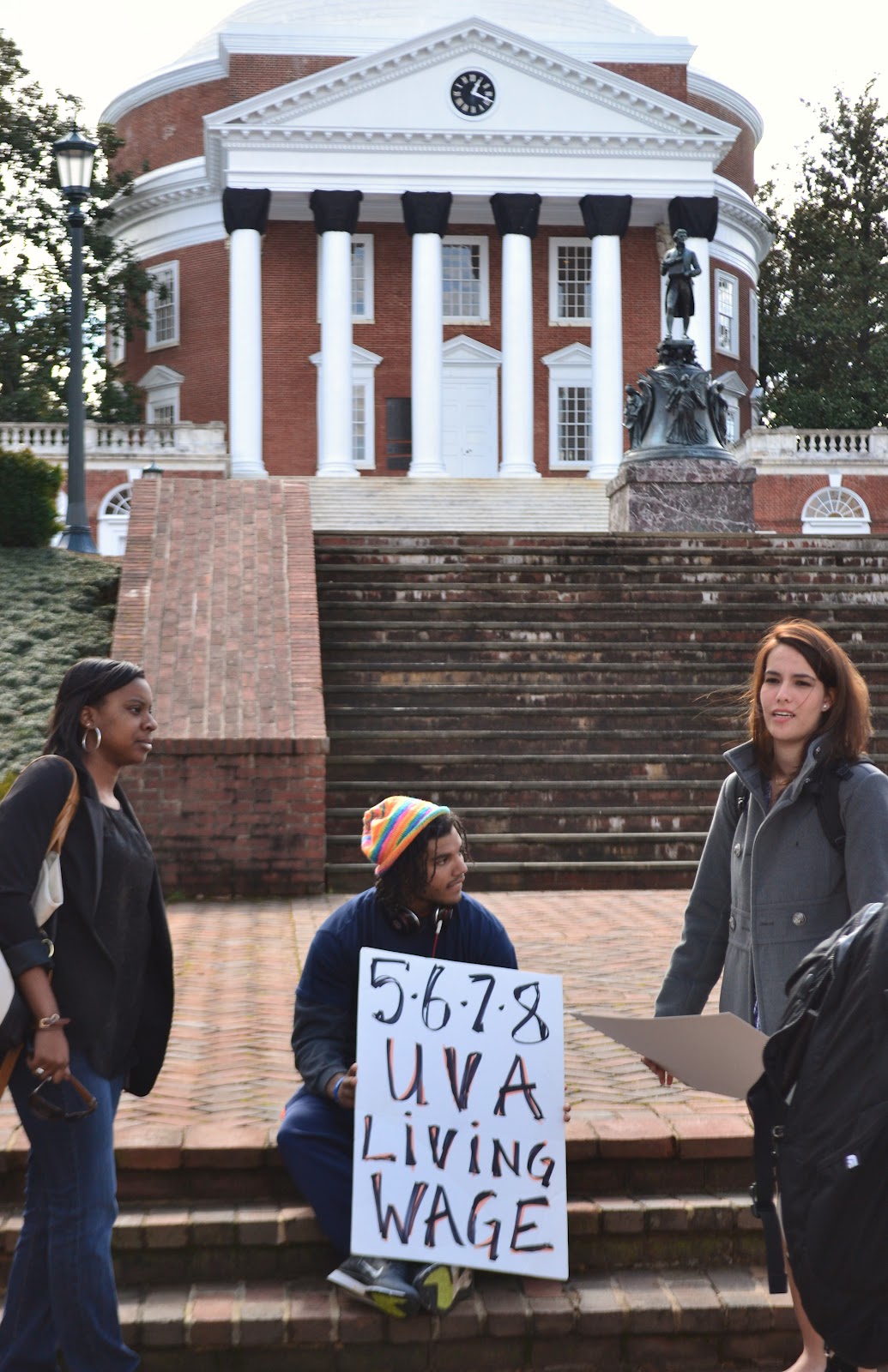
The enthusiasm of the folks behind the UVA Living Wage campaign is truly inspiring. In addition to the now 19 hunger strikers, dedicated supporters have been rallying from 10am - 5pm for over a week outside the Rotunda, maintaining a constant presence to remind the University of its obligations. I've been able to make it out to three of their recent rallies in the past week, and although the song remains the same, it becomes more inspiring each time I hear it. The collective spirit present at the rallies leads it to take on its own character that makes it even greater than the sum of our individual experiences, and, as more and more people show up, the voices becomes stronger and more colorful, creating a chorus that will not be silenced.

Joseph, a football player who's striking.
It's empowering to be surrounding by nearly one hundred people willing to march, shout, and strike for social justice. The strength of a united voice shouting "The people united will never be defeated!" or "1-2-3-4 No one should be working poor/ 5-6-7-8 U-V-A Living Wage!" cannot be denied. It's beautiful to see so many diverse people showing solidarity with the campaign, whether employees, students from different schools at UVA, community members, athletes, professors, club members, or other wagers from other universities. The collective voice of the wagers is full and powerful- it spans a dynamic range of experiences and backgrounds that overwhelms the heterogeneous voice of the Board of Visitors (who represent a very privileged, exclusive tradition).

The new relationships that form as supporters introduce themselves, ask questions, and share their experiences is similarly precious. It's nice to see a public space like the Rotunda steps being used for socioeconomic activism. I've met some inspiring people after rallies, including Joseph, a football player striking on the campaign and students who work alongside employees. The genuine compassion of all of the wagers is visible from the students who are loudly and passionately chanting to those who are on hunger strike and speak with a tired, raspy voice.

The hunger strikers outside Madison Hall last Thursday.
I couldn't help but be reminded of the energy I felt in the Fujimori Nunca Más march in Peru, especially as UVa wagers shouted, "Un pueblo unido nunca será vencido" in solidarity with UVA's latino employees. Yet the Living Wage is a different cause for me. It is more intimate and ingrained in the community that I live in. I interact with underpaid workers every single day at school before, in between, and after classes. Yet it is in my classes where I learn about the values of socio-economic justice and why workers' deserve a dignified wage. I don't want to continue to live in an environment of hypocrisy, which is why I am compelled to join in the discourse, dialogue, and chorus supporting the UVA Living Wage campaign.

It's frustrating, however, to not be heard despite the broad base of support. Five representatives of the campaign, including professors, grad students, and an employee met with President Sullivan yesterday. Although the meeting was on good terms, there has been no progress towards a living wage. How much longer will the hunger strike have to continue? The campaign needs more voices and more bodies for it to succeed. Get involved and speak out!

~
UVA Living Wage Campaign Website
Sign the Change.org Petition 

Photos courtesy of me! Feel free to use under a Creative Common's License with attribution.

Sunday, May 29, 2011

Fujimori nunca más

Students from my university
As I was lying in my bed Thursday night trying to sleep, I could still hear the echoes of the thousands of protesters as they marched through the streets of Lima. "Con justicia y dignidad, Fujimori nunca más." "La juventud consciente. No elije un delicuente." "Chino, chino, chino. Corrupto y asesino." ... Earlier that day, the National Coordinator of Human Rights organized the "With Justice and Dignity, Fujimori No More" march to remember the victims of the government of former Peruvian dictator Alberto Fujimori and to protest the candidacy of his daughter, Keiko Fujimori.

Paper maché Fuji-rata
As I have been involved with part of the campaign against Fujimori, I eagerly attended the march. It was perhaps one of the most unforgettable experiences I've had in Peru so far. I will not forget the sound of thousands of footsteps marching through the street, the passionate, perpetual chants of the activists, the angry horns of the taxis and combis caught in the middle of the mobilization, and the buzz of the spray cans as the protesters inundated the streets in graffiti as we walked. An estimated 10,000-15,000 people attended the march from all sectors of society- lawyers, human rights activists, students, family members of the victims, religious groups, doctors, victims of forced sterilization... Regardless of the their background, everyone present was united by their sincerity and passion to remember the injustices of the Fujimori dictatorship and to prevent it from being resurrected. People of all ages held handmade signs and banners and paraded through the streets with paper maché caricatures of the fujimoristas.

Some crucial background info:
My friend Dorita
Alberto Fujimori was elected president of Peru in 1990, a time in which Peru was struggling with a developing economy and combating two left-wing terrorist groups, Sendero Luminoso and the MRTA. Although he explicitly opposed an economic shock doctrine in his campaign, he instituted a policy of economic shock shortly after assuming power, augmenting already high poverty levels (which had fomented the terrorism in the first place). In 1993, he suspended congress and issued a new constitution to give himself and his party more control over the state apparatus. In 2000, Fujimori was re-reelected president of Peru through fraudulent elections, though public protests eventually forced him to resign (via a fax message) and flee to Japan, where he claimed citizenship. 

Korrupción.
During his regime, it is estimated that Fujimori stole $6 billion from the state, making him the most corrupt Peruvian president and the seventh most corrupt president in the world of all time. In 2009, he was extradited to Peru and found culpable of crimes against humanity because of the assassinations and tortures he authorized. In the two most famous examples, Fujimori's death squad, Grupo Colina, masascred innocent Peruvians (including a child) in Barrios Altos and disappeared, tortured, and murdered 9 students and a professor at La Cantuta University. Fujimori is also guilty for his population control plan which forcibilly sterilized thousands of rural, peasant women. He was also found guilty of embezzlement and bribery. After the trails, Fujimori was sentenced to 25 years in prison, where he now resides and receives hundreds of visits per day. The campaign trucks of his daughter are regularly spotted outside the prison, and some speculate that he is running her campaign.

Catolica University remembers
the victims at La Cantuta.
Despite the fujimoristas legacy of corruption, fear, and massacres, Keiko Fujimori is the frontrunner in the second round of national elections. Keiko has done little to distance her self from her father's dictatorship. She repeatedly refers to his government as "el mejor gobierno de todos los tiempos" (''the best government of all time") and her Plan de Gobierno (Government plan) frequently references her father's government. While her father was president, Keiko essentially became the Primera Dama (First Lady) after her mother separated from her father. Keiko's mother denounced the corruption of Fujimori's regime, and was supposedly tortured in the notorious Sotonos SIE for doing so. Additionally, taxpayers payed hundreds of thousands of dollars for Keiko (and her three siblings) to attend university at expensive schools in the US. Aside from all this, Keiko has done very little in her political career besides skipping an alarming amount of congressional sessions and only authoring 6 marginally important bills in her entire career. 

Why then, are people supporting Keiko? In Lima, many members of the middle and upper class see her as the lesser of two evils. Her opponent, left-wing military strongman Ollanta Humala, is consistently branded by the right-wing press as a Hugo-Chavez figure who would undo all of the economic development Peru has experienced. In rural areas, the fujimoristas operate a sort of political machine or patron-clientilism where they build (poor quality) schools and give handouts for votes that the constituents have now become dependent on.

Who will win on July 5th? Protests all throughout Peru, culminating in the protest in Lima on Thursday, have shown that the legacy of Alberto Fujimori will not be forgotten. However, the majority of the press has backed Keiko, and some news stations have even fired commentators for supporting Ollanta, overshadowing the voice of these people. If Keiko wins, I have no doubt that the protesters will once again hit the streets, but this times with their cries even louder than before... that is, if Keiko doesn't have her own death squad in place by then to stop them.